Home Timeline & Key Events Litigation Tracker FOIA Tracker Governance Boulder Challenge Graphics

Timeline & Key Events

Summary

This timeline records major events, public statements, administrative actions, and congressional oversight surrounding federal efforts to reorganize the National Science Foundation (NSF) and dismantle the National Center for Atmospheric Research (NCAR).

2028

  • September 30, 2028
    UCAR Cooperative Agreement Expires

    The conclusion of UCAR's Cooperative Agreement opens a vulnerable window during which the NSF could execute OMB-directed restructuring plans—including breaking apart key assets like the NWSC supercomputer and aircraft—while NCAR's contractual protections are at their weakest.

2026

  • November 11-18, 2026
    Senator Cassidy advances nominees without public hearings

    Following the 2026 midterm elections, Senate HELP Committee Chairman Bill Cassidy (R-LA) scheduled a November 18 executive session vote to rush through five Trump Administration nominees—including Jim O'Neill for NSF Director—during the final weeks of the 119th Congress, bypassing a public confirmation hearing entirely. Following O'Neill's nomination on March 2, 2026, House Science Committee Ranking Member Zoe Lofgren (D-CA) urged Cassidy to hold a public hearing to examine O'Neill's fitness and temperament—citing his promotion of unproven COVID-19 treatments and his approval of an unethical, $1.6 million sole-source anti-vaccine study while leading the CDC. Public questioning under oath is critical because O'Neill would become the first Director in NSF's 76-year history without a scientific degree or research management experience. If confirmed, O'Neill would serve a 6-year term as NSF Director, playing an integral role in implementing the White House’s Science: A New Golden Age vision (see our September 10th and October 31st updates for information) and accelerating the break-up of the National Center for Atmospheric Research (NCAR).

    Appointing O'Neill also violates the National Science Foundation Act of 1950, which mandates that before any person is appointed as Director, the President must afford the National Science Board (NSB) an opportunity to make recommendations regarding the appointment. Because the entire NSB was dismissed in April 2026, no functioning Board exists to fulfill this advisory role prior to O'Neill's formal appointment.

    Take Action: Colorado Senator John Hickenlooper serves as a member of the Senate HELP Committee and will vote on O'Neill's nomination on November 18. Community members are urged to contact Senator Hickenlooper’s office immediately—and reach out to other HELP Committee members, or use the Union of Concerned Scientists’ one-click Senate action tool—to demand that they oppose advancing O'Neill's nomination out of committee without a public confirmation hearing and vote against his confirmation on the Senate floor.

  • October 31, 2026
    Ranking Member Lofgren Demands Answers on Over a Billion of Withheld FY26 Funds at NSF

    In a letter to National Science Foundation (NSF) Chief of Staff Brian Stone, House Science Committee Ranking Member Zoe Lofgren condemns the Trump Administration’s overhaul of the agency—citing politicized grant cancellations, the firing of the National Science Board, and plans to dismantle facilities like NCAR. Lofgren accuses NSF of violating Congress’s power of the purse by withholding $1.4 billion (nearly 20 percent) of its appropriated FY 2026 research budget in order to divert funds toward unapproved White House "Frontier Initiatives" outlined in NSF's September 10 memorandum, NSF Leadership in a New Golden Age of Science. Ahead of Stone's year-end retirement, Lofgren demands written answers by November 17, 2026, regarding how the withheld funds will be managed and the extent of White House interference, alongside a staff briefing by November 19 and monthly oversight briefings throughout FY 2027.

  • October 21, 2026
    NSF Leadership Announces Year-End Departures

    An internal agency memo reveals that Brian Stone (Chief of Staff, Performing the Duties of the NSF Director) and Acting Chief of Staff Rebecca Keiser will retire by the end of 2026, deepening the agency's leadership vacuum while Jim O'Neill's nomination remains stalled in the Senate.

  • October 16, 2026
    Geostationary Weather Satellites: Next Generation Program Challenges Put Vital Observations at Risk

    A recent GAO report highlights severe cost, schedule, and operational risks in NOAA’s restructured GeoXO satellite program—slashed from six satellites to four and $19.6 billion to $13 billion—warning that missing cost estimates, inadequate contingency planning, and documented gaps could cause a multi-month coverage outage by late 2032. While NOAA agreed to GAO’s recommendations to fix these planning deficiencies, Representative Zoe Lofgren strongly criticized the administration-mandated cuts in an October 19, 2026, letter to NOAA leadership, calling the descoping a dangerous "triumph of ideology over science" that degrades future storm forecasting.

  • September 10, 2026
    National Science Foundation and White House sued for refusing to release government records

    The Union of Concerned Scientists and Environmental Defense Fund have filed a Freedom of Information Act lawsuit against the NSF and OMB for withholding records regarding the Trump administration's plans to dismantle the NSF National Center for Atmospheric Research and eliminate its climate research functions.

  • September 10, 2026
    NSF leadership in a new golden age of science

    Brian Stone (Chief of Staff, Performing the Duties of the NSF Director) outlines a sweeping strategic overhaul implementing the White House’s Science: A New Golden Age vision by shifting toward portfolio-based grantmaking, establishing an internal Office of Metascience, and launching four cross-directorate Frontier Initiatives focused on AI, quantum phenomena, advanced materials, and biological design.

    Responding to the Science: A New Golden Age report, UCS Center for Science and Democracy Director Dr. Jennifer Jones warns that the plan "continues to dismantle the nation's scientific capacity" by replacing independent peer review with politically appointed decision-makers.

  • August 26, 2026
    UCAR files amended complaint against federal administrative agencies

    UCAR expands its lawsuit to include claims against the NSF, NOAA, and OMB for failing to respond to public records requests under the Freedom of Information Act (FOIA).

  • August 20, 2026
    Environmental Defense Fund sues Trump administration over action to dismantle essential climate research center

    The Environmental Defense Fund has filed a lawsuit in federal court challenging the Trump administration's unlawful attempt to dismantle climate research at the National Center for Atmospheric Research and close its historic headquarters in violation of the Administrative Procedure Act and the National Historic Preservation Act.

  • August 7, 2026
    NAS to Conduct Process Review of Chapter in Reference Manual on Scientific Evidence

    Following the publication of the Fourth Edition of the Reference Manual on Scientific Evidence in December 2025—which first included a climate science chapter—West Virginia Attorney General John B. McCuskey and 27 state attorneys general petitioned the Federal Judicial Center (FJC) on January 29, 2026, to withdraw the section. They argued its Columbia University-affiliated authors created a biased "litigation playbook" that compromised judicial neutrality. After the FJC removed the guide, Senator Ron Wyden and Representative Donald Beyer led congressional Democrats on February 27, 2026, in condemning the deletion as political censorship that capitulated to conservative pressure and deprived judges of vital peer-reviewed science. On August 7, 2026, the National Academy of Sciences announced an independent process review into the chapter's development, clarifying that the assessment targeted institutional procedures rather than climate science itself. Finally, on September 1, 2026, Senator Sheldon Whitehouse sent a letter urging FJC Director Robin Rosenberg to restore the IPCC-backed guidance and reject pressure from fossil fuel interests.

  • August 6, 2026
    Kamlager-Dove Introduces Articles of Impeachment Against OMB Director Vought

    Congresswoman Sydney Kamlager-Dove introduced articles of impeachment against OMB Director Vought on August 6, 2026, charging him with abuse of power and failure to faithfully execute the laws. The filing follows the administration's admission that it canceled federal funding—including 79 projects in California—for Democratic-voting states based solely on political criteria from the 2024 election. Vought is accused of unconstitutionally interfering with Congress's power of the purse by improperly impounding congressionally appropriated funds, violating the Congressional Budget and Impoundment Control Act of 1974, and bypassing legislative channels to weaponize federal resources.

    Please watch Katie Phang's interview for more information.

  • July 13, 2026
    Ranking Member Robert Garcia Fights Back Against Trump Administration Attack on Federal Grants, Threatening Vital Programs for Americans

    In a letter led by Representative Garcia and signed by over 100 congressional Democrats, lawmakers demanded that OMB Director Vought immediately rescind a proposed regulation that would grant political appointees broad authority over the approval, termination, and ideological alignment of federal grants.

    The proposed OMB regulation attempted to formalize executive grant restriction policies that were already subject to major legal challenges in our Litigation Tracker.

  • June 1, 2026
    UCAR statement on order granting preliminary injunction

    A federal judge has granted UCAR's request for a preliminary injunction, successfully halting the federal government's planned transfer of the NCAR-Wyoming Supercomputing Center (NWSC) and maintaining the status quo while the underlying lawsuit is fully litigated.

  • May 15-20, 2026
    Colorado Democrats censure Gov. Jared Polis over Tina Peters commutation

    Governor Jared Polis commuted the prison sentence of former Mesa County Clerk Tina Peters, who was convicted of felonies involving the security breach of Colorado’s election systems. While the Governor defended the move as a correction of an overly harsh sentence, the decision drew a formal censure from the Colorado Democratic Party and threatens to undermine ongoing legal battles.

    The University Corporation for Atmospheric Research (UCAR) lawsuit explicitly alleges that the Trump administration’s maneuvers to dismantle the National Center for Atmospheric Research (NCAR) constitute unconstitutional political retaliation against Colorado's independent administration of justice. By commuting Peters' sentence, Governor Polis bolsters the Trump administration's defense by fracturing a core element of the lawsuit.

    Please watch the 60 Minutes special for more information.

  • April 25, 2026
    President Trump has dismissed the entire National Science Board

    Democratic members of Congress sharply condemned President Trump's sudden dismissal of all 22 National Science Board members, alleging that the mass firings violated the National Science Foundation Act of 1950, breached statutory mandates to report to Congress on U.S. scientific competitiveness, and unlawfully bypassed legally required board oversight of NSF spending and budgets [1, 2].

    The National Science Board termination letter reportedly read, "On behalf of President Donald J. Trump, I am writing to inform you that your position as a member of the National Science Board is terminated, effective immediately. Thank you for your service."

    The American Institute of Physics reports that the White House justified its sudden, unannounced dismissal of the entire National Science Board by citing a 2021 Supreme Court ruling (U.S. v. Arthrex) regarding non-Senate-confirmed appointments. However, the board's non-confirmed status stems from the Presidential Appointment Efficiency and Streamlining Act of 2011, which deliberately removed Senate confirmation requirements for the NSB and numerous other advisory positions. Fired board members, Democratic lawmakers, and scientific societies widely condemned the administration's legal rationale as a pretextual and destabilizing attack on independent scientific oversight.

  • March 17, 2026
    University statement on the preservation of NCAR

    The University of Colorado Boulder (CU) released its response to the NSF-DCL, proposing to replace the management of NSF NCAR with a restrictive three-university consortium consisting of CU, the University of Wyoming, and the University of Oklahoma.

    In our analysis, A Critical Review of the University of Colorado Boulder Response to the NSF-DCL, we argue the proposal is strategically defeatist and threatens to undermine the integrity of the ongoing NSF Inspector General investigation and the UCAR lawsuit. The proposal contains fundamental contradictions and conflicts of interest that could disenfranchise the 129-member university consortium currently managed by UCAR.

    Murray Smith, candidate for the CU Board of Regents (District 2), responded to our concerns for the CU-DCL stating: "I am generally in agreement with you that UCAR is a better governance structure than the three-university one."

  • March 16, 2026
    UCAR statement on lawsuit filed against federal administrative agencies

    The University Corporation for Atmospheric Research (UCAR) filed a lawsuit against several federal agencies, including the NSF and NOAA, alleging that their recent adverse actions violate the Constitution and the Administrative Procedure Act while threatening national security and global leadership in Earth system science.

  • March 9, 2026
    Rep. Neguse Calls For Inspector General Investigation Into OMB, National Science Foundation & Allegations of Potential Sale of NCAR to For-Profit Corporation

    In this formal letter to the NSF Inspector General, concerns are raised regarding potential conflicts of interest and illegal attempts by the Trump administration to dismantle the National Center for Atmospheric Research (NCAR). Congressman Neguse cites troubling reports that OMB officials may have pre-negotiated the transfer of NCAR’s space weather programs to a specific for-profit company before the official "Dear Colleague" (DCL) public process had even concluded. The letter argues that such a move would violate the PROSWIFT Act, which mandates that basic space weather research remain within federal agencies, and characterizes the NSF’s recent restructuring announcements as a "political ploy" to feign due process for predetermined outcomes. Ultimately, the Inspector General is urged to investigate whether these actions bypass competitive merit-review laws and constitute an improper sell-off of public assets to private interests.

  • March 2, 2026
    Nominations Sent to the Senate

    James O’Neill, of Texas, to be Director of the National Science Foundation for a term of six years.

  • January 27, 2026
    As NCAR Faces Potential Dismantling, Rep. Neguse Calls on Coloradans to Make Voices Heard During NSF Public Comment Period

    In response to the NSF's "Dear Colleague Letter" regarding the potential restructuring of the National Center for Atmospheric Research (NCAR), Congressman Joe Neguse strongly condemned the proposal and urged Coloradans to submit public comments to oppose the agency's potential dismantling. To view formal responses from the scientific community, please see the extensive collection of letters compiled by The Weather & Climate Livestream and our response to the NSF-DCL.

  • January 23, 2026
    NSF Intent to Restructure Critical Weather Infrastructure

    In the controversial Dear Colleague Letter, the National Science Foundation (NSF) requested community input and concepts to help restructure the operations, management, and facilities of the NSF National Center for Atmospheric Research (NCAR). A related initiative announced on February 12, 2026, to transition the NCAR-Wyoming Supercomputing Center (NWSC) is not open to public feedback.

  • January 9, 2026
    Congressman Neguse Statement on Final Passage of Three-Bill Fiscal Year 2026 Minibus

    “Colorado’s research institutes and laboratories are central to the fabric of our state and our nation, and I’m deeply grateful to the colleagues who joined me in pushing back against the Trump administration’s attacks on the National Oceanic and Atmospheric Administration and the National Center for Atmospheric Research. While I’m proud that we succeeded in ensuring the CJS funding bill rolled back dangerous cuts to NOAA — preventing irreversible harm to critical programs — I could not, in good faith, support legislation that fails to safeguard the extraordinary work being done at NCAR. Dismantling this institution would be reckless, dangerous and place the United States at a serious competitive disadvantage. I urge the Trump administration to heed our bipartisan call for a halt to their attacks on this vital institution — and I’ll continue to work with Senators Bennet and Hickenlooper and the bipartisan coalition we’ve built to protect NCAR.”
    — Congressman Neguse

Save NCAR

2025

  • December 22, 2025
    Colorado Reps. Neguse & Hurd and Senators Bennet & Hickenlooper Mobilize Bipartisan, Bicameral Coalition to Protect NCAR

    In a bipartisan and bicameral letter dated December 22, 2025, over 70 members of Congress urged the House and Senate Appropriations Committees to provide sustained funding for the National Center for Atmospheric Research (NCAR) in the FY 2026 budget. The lawmakers define NCAR as a vital national security and economic asset, highlighting its role in wildfire behavior analysis, agricultural planning, and the prediction of solar storms that threaten GPS and banking satellites. By emphasizing the essential nature of the NCAR-Wyoming Supercomputer Center and the facility's "open modeling" frameworks that reduce research duplication, the letter frames NCAR not just as a scientific center, but as a high-value federal investment that protects American lives and infrastructure from extreme weather and atmospheric disruptions.

  • December 20, 2025
    Hundreds protest Trump’s move to dismantle NCAR, a premier climate and weather hub

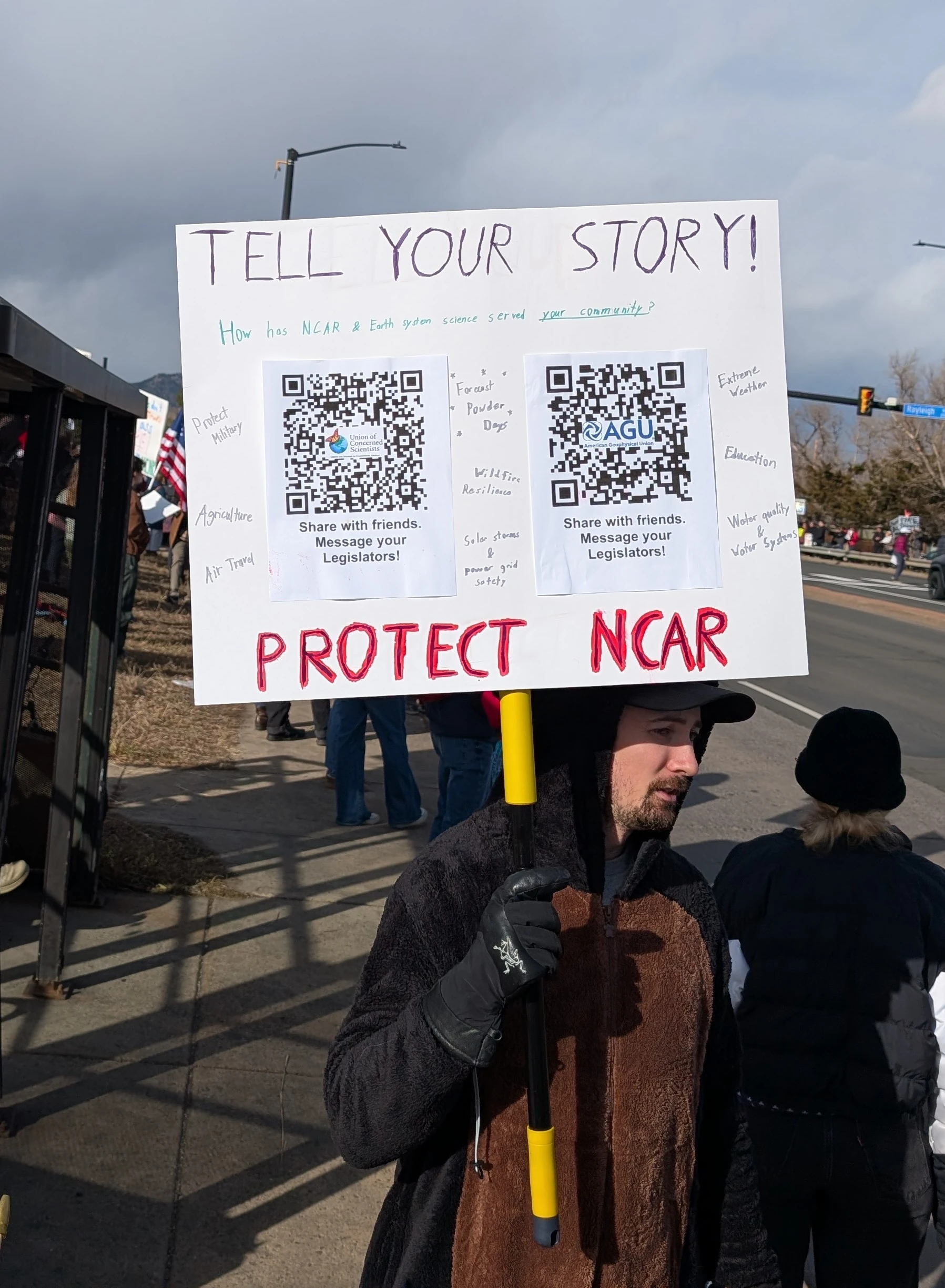
    Hundreds of protesters—joined by elected officials like Rep. Joe Neguse and Sen. John Hickenlooper—gathered in Boulder to rally against the Trump administration's plan to dismantle the National Center for Atmospheric Research (NCAR), while federal lawmakers pledged to fight the decision by leveraging government spending legislation and exploring legal action.

  • December 18, 2025
    Hickenlooper, Bennet Hold Appropriations Package to Demand NCAR Funding

    “President Trump is attacking Colorado because we refuse to bend to his corrupt administration. His reckless decision to dismantle the National Center for Atmospheric Research will have lasting, devastating impacts across the country. We are holding the Senate’s appropriations package to demand full funding for NCAR. As Trump’s rampage continues, we will pull every lever available to do what is right for Colorado.”
    — Senators Hickenlooper and Bennet

  • December 17, 2025
    Trump moves to dismantle major US climate research center in Colorado

    “The National Science Foundation will be breaking up the National Center for Atmospheric Research in Boulder, Colorado. This facility is one of the largest sources of climate alarmism in the country. A comprehensive review is underway and any vital activities such as weather research will be moved to another entity or location.”
    — Russell Vought, White House Office of Management and Budget Director

    Vought’s statement came as Boulder was simultaneously battered by a December 17–19 windstorm with gusts exceeding 100 mph. Widespread power shutoffs were ordered to mitigate wildfire risks reminiscent of the nearby 2021 Marshall Fire—reinforcing the intensifying threats of climate change at that precise moment.

    For additional background, watch the news report from PBS NewsHour on the White House push to dismantle NCAR.

  • November 15, 2025
    NSF Director Vacancy

    The 210-day limit for authorized acting service in the NSF Director role expired today, marking a significant legal transition for the agency's leadership. Per GAO guidance, because the vacancy originated with the resignation of Director Panchanathan on April 24, 2025, the NSF was required to discontinue the use of the "Acting Director" title to remain in compliance with the Federal Vacancies Reform Act. While the position is now legally vacant, essential agency functions continue to be maintained by senior staff specifically authorized to perform the duties of the office.

  • November 14, 2025
    GSA and NSF Announce NSF Headquarters Relocation

    The GSA and NSF announced that the NSF is moving its headquarters from 2415 Eisenhower Ave to the Randolph Building at 401 Dulany Street, both located in Alexandria, VA. Much like NCAR’s Mesa Lab, the 2415 Eisenhower Ave building was custom-built to address the NSF's unique operational needs and was inaugurated as its headquarters in 2017. The move faced sharp pushback from lawmakers, starting with a June 27, 2025 letter from Virginia Senators Mark Warner and Tim Kaine and Representative Don Beyer raising serious concerns over the displacement of roughly 1,800 NSF employees. This was followed by a March 26, 2026 letter from Democratic lawmakers strongly opposing HUD Secretary Scott Turner's plan to shift 20 program offices to Alexandria, citing statutory violations, operational chaos, and workforce depletion.

  • May 30, 2025 and June 14, 2025
    Scientific Societies Issue Letter to Congress Regarding National Science Foundation Reorganizations and Cuts

    In a joint letter to Congressional leadership, a broad coalition of over 50 professional scientific societies and research organizations—including the American Physical Society, the American Chemical Society, and the Association of American Universities—expresses deep alarm over the "imminent threats" facing the National Science Foundation (NSF). While acknowledging the agency's 75-year legacy of driving innovation and supporting 268 Nobel laureates, the signatories warn that recent "abrupt" developments—specifically mass layoffs, the cancellation of curiosity-driven research programs, the termination of active grants, and the unilateral slashing of indirect cost rates—risk causing irreversible damage to the U.S. scientific enterprise. The coalition urges the Senate and House committees to exercise their oversight authority to investigate whether these actions, taken in anticipation of budget cuts rather than following Congressional appropriations, violate statutory directives and undermine the merit-review framework that has secured decades of American technological and economic leadership.

  • May 20, 2025
    Senator Warren to Director Kratsios (Funding Cuts)

    In this letter dated May 20, 2025, Senators Elizabeth Warren and Edward J. Markey confront OSTP Director Michael Kratsios regarding the "disarray" and "upheaval" at the National Science Foundation (NSF) under the Trump Administration. The Senators highlight a series of catastrophic disruptions—including the termination of over 1,400 grants, an unprecedented secondary review of previously approved awards, an indefinite funding freeze, and a restrictive 15% cap on indirect costs—that they argue defy court orders and jeopardize U.S. scientific leadership. They emphasize that these actions have already caused tangible harm in Massachusetts, forcing research institutions to slash incoming class sizes and scramble for alternative student support. Following the resignation of NSF Director Panchanathan and reports of a looming 55% budget cut and a radical restructuring that would abolish the agency’s 37 divisions, the Senators demand that Kratsios explain how he will safeguard the scientific enterprise from political interference and "DOGE"-led downsizing, requesting detailed answers on the criteria being used to align federal research with the Administration's ideological executive orders.

  • May 8, 2025
    House of Representatives Letter to Acting NSF Director Stone (Funding Cuts)

    In this letter dated May 8, 2025, House Science Committee Democrats condemn a "disastrous week" for the National Science Foundation (NSF) under Acting Director Brian Stone, marked by the termination of over 1,400 grants totaling more than $1 billion and an indefinite freeze on all funding actions. The authors characterize these actions as a "draconian" and "politically motivated" betrayal of the agency’s gold-standard merit review process, specifically citing the Department of Government Efficiency’s (DOGE) public celebration of canceling hundreds of "wasteful DEI grants" that had previously passed rigorous scientific evaluation. The letter highlights several abruptly canceled projects—including rural STEM education, deepfake detection, and quantum workforce development—and argues that these terminations likely violate the Impoundment Control Act and a standing court injunction against impeding appropriated funds. Furthermore, the committee leaders demand transparency regarding a new 15% cap on indirect costs and the extent of DOGE’s decision-making power within the agency, warning that these "destructive decisions" cause irreparable injury to the American scientific enterprise and the next generation of researchers.

  • April 24, 2025
    Statement by Director Sethuraman Panchanathan on his departure

    On April 18, 2025, NSF Director Sethuraman Panchanathan issued a priorities statement that left the scientific community facing significant ambiguity due to a confusing shift in the statutory criteria for granting awards. Just six days later, on April 24, Panchanathan abruptly stepped down after five years of leadership, departing with a plea to safeguard America's competitive edge and urging sustained investment to maintain U.S. scientific dominance. However, the administrative transition quickly gave way to a period of controversial policy shifts under acting leadership, marking a sharp departure from the agency's long-standing practices.

  • April 17, 2025
    House of Representatives Letter to NSF Director Panchanathan (Cruz Report)

    In this letter dated April 17, 2025, Representative Zoe Lofgren, Ranking Member of the House Committee on Science, Space, and Technology, urges NSF Director Sethuraman Panchanathan to defend the agency’s merit review process against a report by Senator Ted Cruz that labeled over 10% of NSF grants as "questionable" due to alleged DEI or neo-Marxist content. Lofgren asserts that the Cruz Report is demonstrably false and based on unscientific keyword searches that flagged benign research—such as studies on concussion "trauma" or "female" leopard seals—simply for including words on a politicized list. Expressing alarm over reports that the NSF is currently using these same terms to conduct post-hoc reviews of active grants in response to Trump Administration executive orders, Lofgren demands transparency regarding the review methodology and the potential consequences for flagged researchers. She concludes by requesting a formal response by April 25, 2025, to ensure that scientific funding remains dictated by expert merit rather than political intimidation.

  • March 11, 2025
    House of Representatives Letter to NSF Director Panchanathan (DOGE)

    In this letter dated March 11, 2025, Ranking Members of the House Committee on Science, Space, and Technology urge NSF Director Sethuraman Panchanathan to protect the agency’s core mission against "slash and burn" restructuring efforts led by the Department of Government Efficiency (DOGE). The authors argue that mass federal firings have already caused administrative chaos and that further reductions in force would jeopardize American competitiveness against rivals like China, specifically in areas of research security, STEM education, and polar operations. Furthermore, the letter asserts that failing to spend Congressional appropriations as intended violates the Impoundment Control Act, and it demands that the NSF immediately provide the Committee with its reorganization plan and a briefing on its projected impacts to ensure the agency remains capable of fulfilling its statutory obligations.

Save NCAR

2024

  • October 8, 2024
    "Cruz Report"

    The Cruz Report alleges that the National Science Foundation has increasingly politicized taxpayer-funded research by diverting over $2.05 billion toward 3,483 grants that promote DEI tenets or neo-Marxist ideologies, thereby undermining scientific merit and radicalizing American campuses.

Save NCAR